The light bulb, the airplane, the transistor, the internet, GPS, mRNA vaccines and ChatGPT all have something in common: each was invented or first developed in the United States. None of them came from a lone genius alone. Behind them stands a system that took shape over more than a century: government money for risky research, universities that train scientists, companies and investors willing to bet on new ideas, and a steady flow of talent from abroad. This chapter traces how that system was built, what it produces today in chips, artificial intelligence and space, and why many experts now worry about whether it can keep its lead.
From the light bulb to the airplane
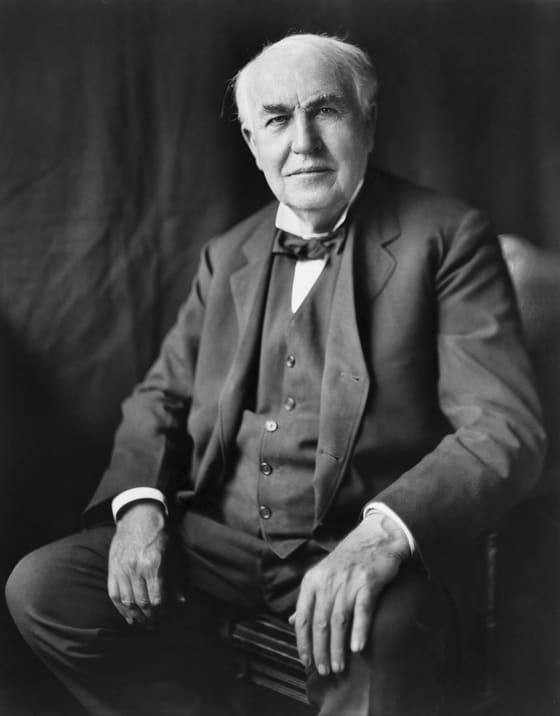
America's reputation for invention began in the late 1800s, when a young industrial nation started producing tinkerers who worked like businesses. The most famous was Thomas Edison. At his laboratory in Menlo Park, New Jersey, he and his team developed the first practical incandescent light bulb in 1879.19
Edison understood that a bulb was useless without electricity to power it. So he also designed a complete system of generators, wires, meters and switches. On September 4, 1882, his Pearl Street Station began supplying power to part of New York City, opening the age of electric light.19 By the time he died in 1931, Edison held 1,093 US patents.19
What made Edison new was not just his ideas but his method. Menlo Park was an "invention factory": a team of machinists, chemists and engineers testing idea after idea on a schedule. That model, a research lab organized for steady discovery, would later be copied by giants such as Bell Labs, General Electric and IBM.
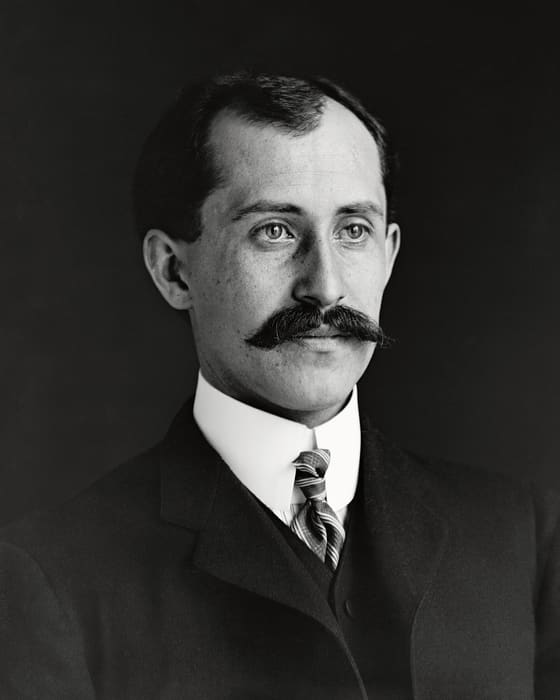
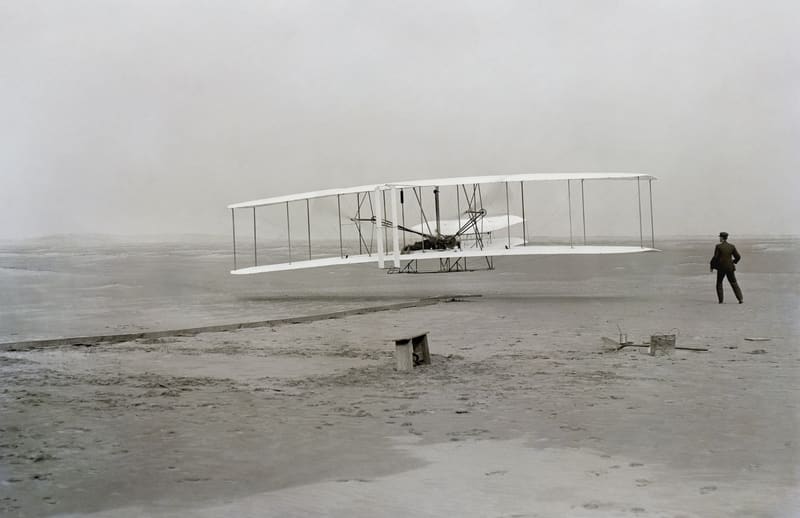
A generation later, two bicycle makers from Dayton, Ohio, solved one of history's oldest puzzles. On December 17, 1903, on a beach at Kitty Hawk, North Carolina, Orville Wright flew the Wright Flyer for 12 seconds and 120 feet. Later that morning Wilbur flew 852 feet in 59 seconds.17 The brothers had no university degrees and little money. What they had was careful testing, including their own wind tunnel, and the patience to fail many times before they succeeded.
War, computers and the internet
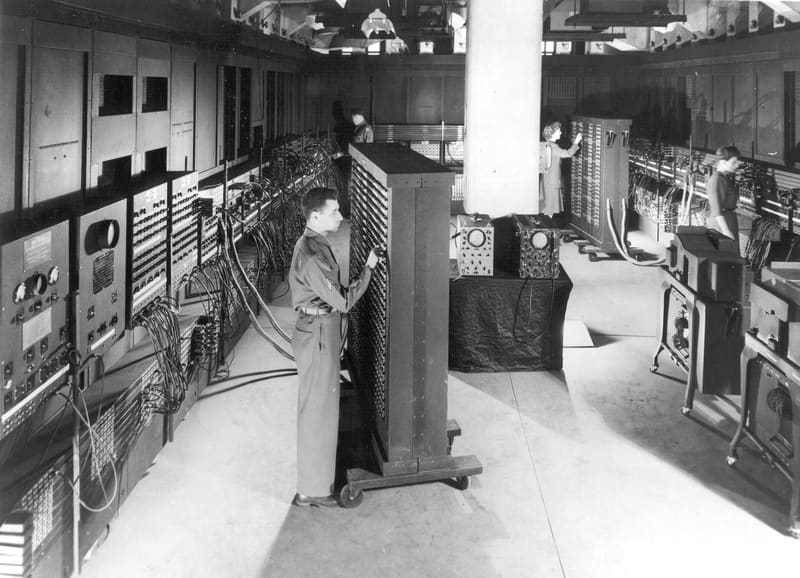
World War II changed how America invented. The government poured money into science to win the war, and scientists delivered radar, new medicines and the first electronic computers. At the University of Pennsylvania, a team led by John Mauchly and J. Presper Eckert built ENIAC for the US Army. Announced in February 1946, it filled a room, weighed 30 tons and used 18,000 vacuum tubes. It could finish in 30 seconds a ballistics calculation that took 12 hours on a desk calculator.18
In 1945, Vannevar Bush, who had run the wartime research effort, sent President Truman a report called Science, the Endless Frontier. It argued that the government should keep funding basic research at universities in peacetime.11 That idea shaped the postwar system and helped lead to the National Science Foundation, created in 1950.7
Two inventions then made modern electronics possible. In 1947, John Bardeen and Walter Brattain at Bell Telephone Laboratories built the first transistor, a tiny switch that could replace bulky vacuum tubes. With William Shockley, they won the 1956 Nobel Prize in Physics.13 About a decade later, Jack Kilby at Texas Instruments and Robert Noyce at Fairchild Semiconductor independently showed how to put many transistors on one piece of semiconductor: the integrated circuit, or microchip. Kilby received the Nobel Prize in 2000.14
When the Soviet Union launched Sputnik in 1957, Washington responded by creating the Advanced Research Projects Agency (ARPA, now DARPA) in 1958 to prevent another "technological surprise."12 ARPA funded a network to link research computers. On October 29, 1969, a computer at UCLA sent the first message to one at the Stanford Research Institute. The system crashed after two letters, "LO," but worked within the hour.23 That network, ARPANET, grew into the internet.
The military also built GPS. The first satellite launched on February 22, 1978, and the full constellation of 24 satellites was declared operational in 1995.16 Today the same signals guide ships, farm tractors and ride-share apps. DARPA itself remains small, with an enacted budget of $4.3 billion for fiscal 2026, but it credits its projects with shaping the internet, voice recognition, GPS receivers small enough for phones and early work on mRNA vaccines.12
Scientific progress is one essential key to our security as a nation, to our better health, to more jobs, to a higher standard of living, and to our cultural progress.
Who spends the most on research?
Research and development (R&D) spending measures how much a country invests in new knowledge, from university labs to corporate engineering. For decades the US led easily. In 2024, according to OECD data, China moved just ahead once prices are adjusted for what money buys in each country (PPP).1
Gross domestic spending on R&D, 2024
Billions of US dollars, adjusted for purchasing power (current PPP)
Both countries now spend about $1 trillion a year. The US still invests a larger share of its economy: 3.4% of GDP in 2024, compared with 2.7% in China and an OECD average of 2.7%. South Korea (5.1%) and Israel (6.8%) spend an even larger share.1
Most US R&D is paid for and carried out by companies. The federal government focuses on basic research, defense and health. Its role in university science produced a famous example: in 2005, Katalin Karikó and Drew Weissman at the University of Pennsylvania discovered how to modify mRNA so the body would not reject it. That work made the COVID-19 mRNA vaccines possible and won the 2023 Nobel Prize in Medicine.15
Federal science budgets are now under pressure. For 2026, the White House proposed cutting the National Science Foundation by 56% and the National Institutes of Health by about 41%. Congress rejected most of those cuts: NSF got $8.8 billion (down 3%) and NIH $47.5 billion (up 1%).7
Silicon Valley, start-ups and chips
The region south of San Francisco got its nickname from the silicon used in chips. Fairchild Semiconductor, where Robert Noyce worked, spun off many new chip companies, including Intel. Over time the area developed a formula that other places have tried to copy: top universities such as Stanford and Berkeley, engineers willing to leave safe jobs, and venture capitalists who fund risky start-ups in exchange for a share of the company.
That formula still attracts most of the world's risk capital. In 2025, investors put about $425 billion into start-ups worldwide, and roughly $274 billion, or 64%, went to US companies. About half of all global venture money went to AI companies.5
Immigrants play an outsized role. A June 2026 study found that 455 of the 775 US start-ups valued at $1 billion or more, or 59%, had at least one immigrant founder. Almost one in four had a founder who first came to America as an international student.8
On patents, the picture is more mixed. In 2025, inventors in China filed 73,718 international patent applications through the World Intellectual Property Organization, compared with 52,617 from the US. US filings fell 3%, the third straight yearly decline.6
Chips show both strength and weakness. American firms design many of the world's most advanced chips, but most are manufactured abroad. Taiwan's TSMC makes almost every leading AI chip.2 The US share of global chip-making capacity fell to about 10% by 2022.9 That year Congress passed the CHIPS and Science Act, signed on August 9, 2022. It set aside $52.7 billion, including $39 billion in manufacturing incentives, plus a 25% tax credit for building chip plants.10 Industry analysts project that US capacity will triple between 2022 and 2032, lifting its global share to 14%, and its share of the most advanced chip production from zero to 28%.9 These are projections, and they depend on factories being finished on time.
The race for artificial intelligence
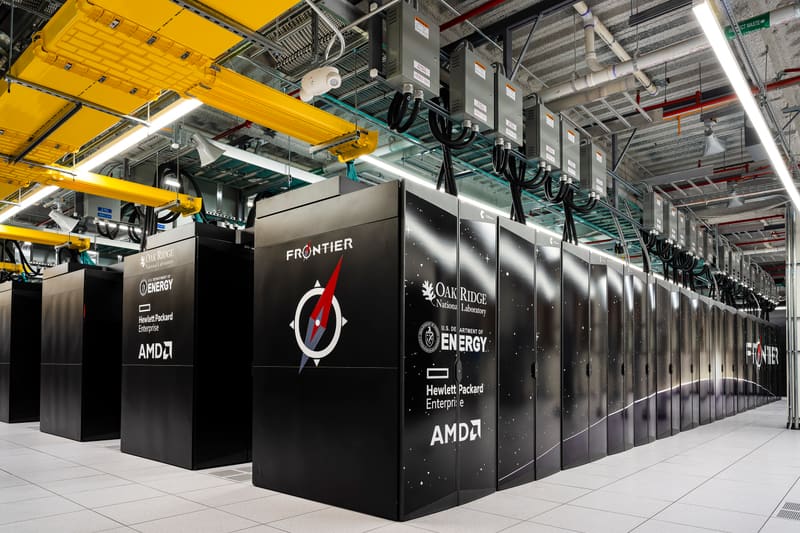
Large language models, the technology behind chatbots, became a mass product when OpenAI released ChatGPT on November 30, 2022.22 Since then, money has poured into AI. Private investment in AI companies in 2025 was heavily concentrated in the United States.3
Private investment in AI companies, 2025
Billions of US dollars
US private AI investment reached $285.9 billion in 2025, about 23 times China's $12.4 billion and 48 times the UK's $5.9 billion. More than half of the US total, $163.6 billion, went to generative AI. The US also had 1,953 newly funded AI companies, against 172 in the UK and 161 in China.3
Most frontier AI is now built by companies, not universities: industry produced more than 90% of notable AI models in 2025.2 The leading US labs, such as OpenAI, Google DeepMind and Anthropic, need vast amounts of computing power, so cloud providers are spending at record levels. Google alone reported more than $150 billion in capital spending in 2025.3 Consumers are getting real value too. Researchers estimate that Americans gained about $172 billion a year from generative AI tools by early 2026, most of which are free or nearly free.3
These numbers do not tell the whole story. China's government guidance funds are estimated to have put about $184 billion into AI firms between 2000 and 2023, money that does not appear in private investment totals.3 And the performance gap is small: by March 2026, the best American model led the best Chinese model by only 2.7% on a leading benchmark. The US produces more top models, while China leads in AI research papers and patents.2
The new space industry
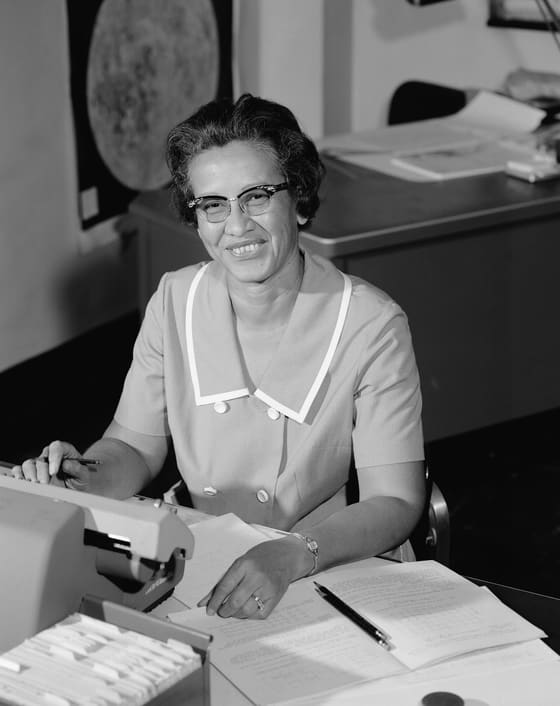
Space shows how far the public-private model has come. In the 1960s, NASA's Apollo program was run by the government, with thousands of contractors building rockets to its designs. Mathematicians such as Katherine Johnson calculated by hand the paths that carried astronauts into orbit and helped plan the Moon landings.21
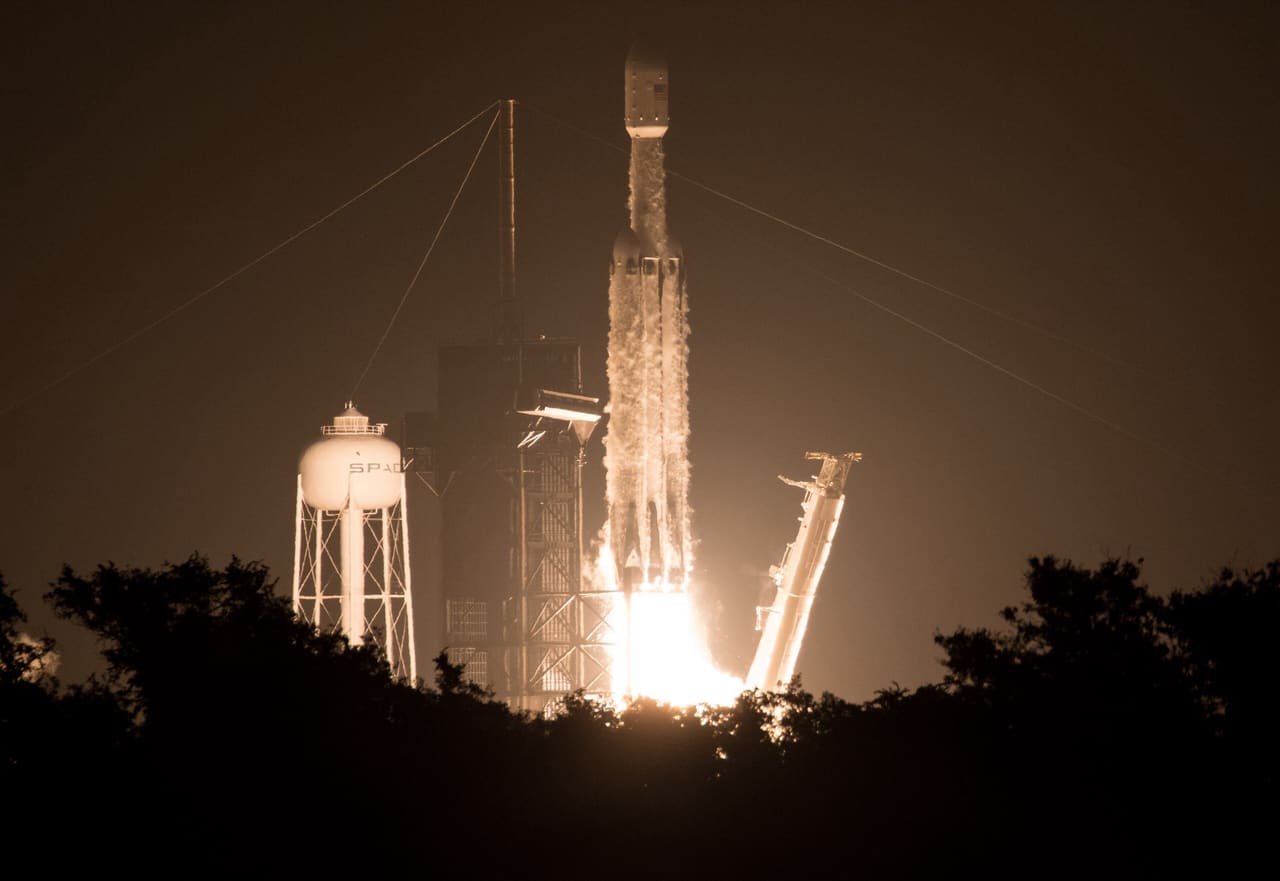
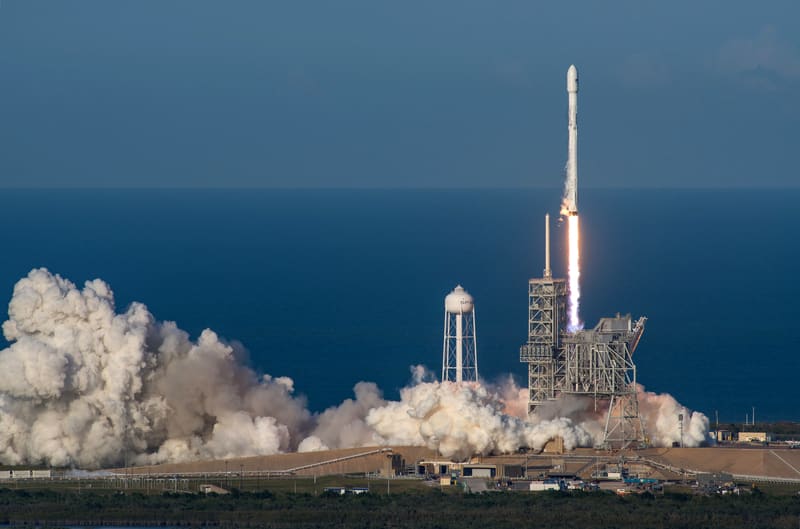
Since the 2000s, NASA has increasingly bought launch services from private companies instead of owning the rockets itself. Firms such as SpaceX, Rocket Lab and Blue Origin build and fly their own vehicles, and SpaceX's Falcon 9 lands its first stage so it can be reused. That has turned launches from rare events into a routine business.
The result is visible in the numbers. In 2025, the world attempted a record 329 orbital launches. Launches from the United States made up 181 of them, more than any country has ever managed in one year, and 179 of them reached orbit. China was second with 92 attempts, and Russia third with 17.4 Most US launches carry satellites for internet networks such as Starlink.
China's space program is also growing fast, with its own crewed space station and plans to land astronauts on the Moon. The competition in orbit, as on Earth, is increasingly between the US and China.
Launches to orbit by country
Counting orbital launch attempts in 2025 by the country they lift off from shows how concentrated access to space has become.4
Orbital launch attempts by launch country, 2025
Number of launch attempts
The 17 launches from New Zealand were flown by Rocket Lab, a US-headquartered company, so American companies flew about 60% of all launch attempts in 2025. European launches from French Guiana, Indian and Japanese flights together added fewer than 20.4
Lower launch costs matter beyond rockets. Cheaper access to orbit makes it possible to deploy large satellite networks for broadband internet, Earth observation and navigation, which is why launches jumped so quickly: from 262 attempts worldwide in 2024 to 329 in 2025.4